Saturday, June 22, 2024

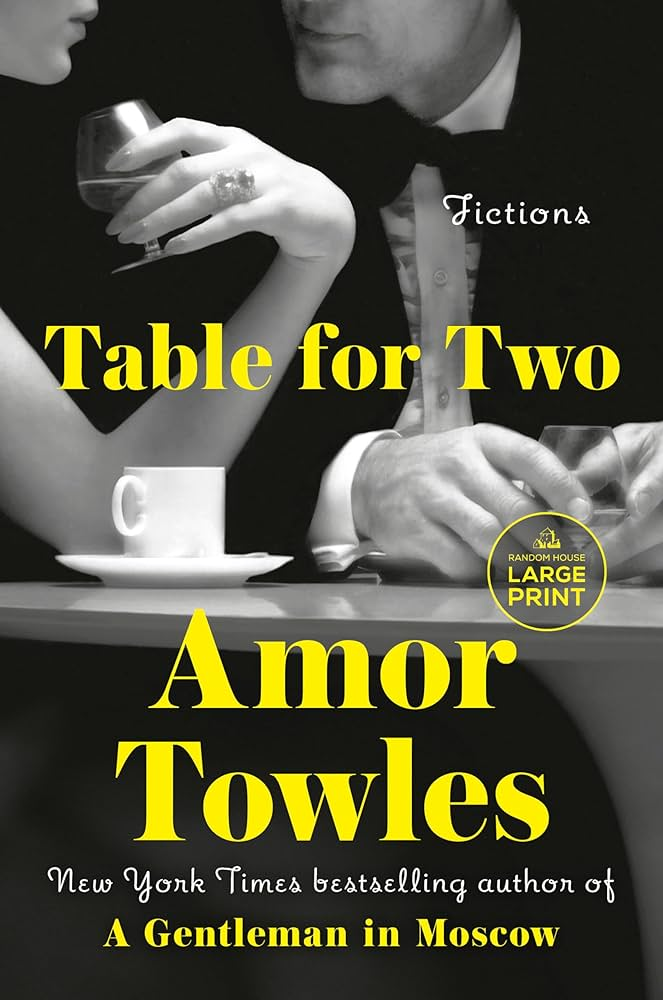
Table for Two by Amor Towles

 Amor Towles rarely disappoints. Unlike his other three books (The Lincoln Highway, A Gentleman in Moscow, and Rules of Civility), Table for Two is a collection of six short stories, all set in NYC, plus a novella. The novella builds on Rules of Civility, following Evelyn Ross, a character from that book, to Hollywood. Interesting characters, plot twists, and vivid imagery - what more can you ask for!

Sunday, May 19, 2024

Either/Or by Kierkegaard

On my journey to understand Existentialism better, I have recently taken on the project to read Either/Or by Kierkegaard. This is perhaps one of the most rigorous literary undertakings that I have pursued, for I find it hard to read and understand Kierkegaard. Yet I'm drawn to grapple with this work as it laid foundations for the existentialist tradition through its exploration of aesthetic and ethical life-views. In Either/Or, Kierkegaard asked probing questions, including how should one live life, what constitutes authentic existence and selfhood, how does one find meaning amidst existential dread and anxiety, among other things.


Monday, April 22, 2024

On the Heights of Despair by Emil Cioran

In my quest to understand continental philosophy, particularly existentialism, I came across the work of Romanian philosopher Emil Cioran titled "On the Heights of Despair." In this book, Cioran inquires about human existence and the role of despair and suffering. Through the 66 titled sections, Cioran urges us to confront despair directly rather than avoiding it.


Sunday, March 31, 2024

The Myth of Sisyphus by Camus

Although Camus rejected the label of an Existentialist philosopher, it makes sense to read him within this philosophical tradition. His exploration of existential themes resonates with the core tenets of existentialism. In “The Myth of Sisyphus,” Camus poses the fundamental question: Is life worth living in a world devoid of any inherent order or meaning? (The short answer: yes.) Camus contemplations make us to confront the absurdity of existence, where the struggle for purpose persists despite the universe’s indifference. 

The following first paragraph from the book is such a great opening...

"There is but one truly serious philosophical problem, and that is suicide. Judging whether life is or is not worth living amounts to answering the fundamental question of philosophy. All the rest— whether or not the world has three dimensions, whether the mind has nine or twelve categories—comes afterwards. These are games; one must first answer. And if it is true, as Nietzsche claims, that a philosopher, to deserve our respect, must preach by example, you can appreciate the importance of that reply, for it will precede the definitive act. These are facts the heart can feel; yet they call for careful study before they become clear to the intellect"

Sunday, March 3, 2024

Nausea by Jean-Paul Sartre

Keeping up with the existentialism theme for the year, I have been reading Nausea by Sartre. The book explores the central theme of existentialism: the idea that existence precedes essence. This philosophical idea marks a departure from the traditional school of thought that individuals have a predefined essence or nature. Through the character of Antoine Roquentin, Sartre explores the emptiness and absurdity of life.

Sunday, February 4, 2024

Existentialism revisited

I plan to spend 2024 delving deeper into existentialism. While I am somewhat familiar with the general concepts of Husserl’s phenomenology, the existence of God in Kierkegaard’s existentialism, and Camus’s absurdism, I have yet to fully immerse myself in their works. This year, I am challenging myself to understand more about the principle that existence precedes essence. To help in this journey, I have chosen to read At the Existentialist Café by Sarah Bakewell, having enjoyed reading book below (How To Live: A Life Of Montaigne) by her last year.


Saturday, November 4, 2023

How to Live

Recently, I have started to read How to Live: A Life of Montaigne in One Question and Twenty Attempts at an Answer by Sarah Bakewell. For anyone interested, here are the 20 themes discussed in the book: 

Don't worry about death;
Pay attention;
Be born;
Read a lot, forget most of what you read, and be slow-witted;
Survive love and loss;
Use little tricks;
Question everything;
Keep a private room behind the shop;
Be convivial: live with others;
Wake from the sleep of habit;
Live temperately;
Guard your humanity;
Do something no one has done before;
See the world;
Do a good job, but not too good a job;
Philosophize only by accident;
Reflect on everything; regret nothing;
Give up control;
Be ordinary and imperfect;
Let life be its own answer.

Sunday, August 13, 2023

Trust by Hernan Diaz


I just finished reading Trust, the 2022 Pulitzer Prize Winner for Fiction by Hernan Diaz. The novel begins in New York City in 1927 and ends in 1938, chronicling the collective experience of the stock-market crash of 1929 and the Great Depression. The book explores themes such as class, power, and money, and how they can be used to control the truth, thereby controlling the narrative. Here is an excellent review of the book by The Atlantic.


Thursday, June 22, 2023

Law and Manners By Lord Moulton

I came across Lord Moulton’s incredible essay titled “Law and Manners” while listening to the EconTalk podcast. In his essay, Moulton discusses unwritten rules, or the Obedience of the Unforceable, that fall between Positive Law and Free Choice. The central tenet of the essay is that Positive Law provides a necessary but not sufficient framework for regulating human manners. He, therefore, argues that manners are crucial in maintaining social stratum. Here is a direct quote from the essay that emphasizes this theme — 

“In order to explain my title I must ask you to follow me in examining the three great domains of human action. First comes the domain of positive law, where our actions are prescribed by laws which must be obeyed. Next comes the domain of free choice, which includes all those actions as to which we claim and enjoy complete freedom. But between these two there is a third large and important domain in which there rules neither positive law nor absolute freedom. In that domain there is no law which inexorably determines our course of action, and yet we feel that we are not free to choose as we would. The degree of this sense of a lack of complete freedom in this domain varies in every case. It grades from a consciousness of a duty nearly as strong as positive law to a feeling that the matter is all but a question of personal choice. Some might wish to parcel out this domain into separate countries, calling one, for instance, the domain of duty, another the domain of public spirit, another the domain of good form; but I prefer to look at it as all one domain, for it has one and the same characteristic throughout — it is the domain of Obedience to the Unenforceable. The obedience is the obedience of a man to that which he cannot be forced to obey. He is the enforcer of the law upon himself.”


Sunday, April 30, 2023

What am I reading?

To those who follow my blog and want to keep up with my literary endeavors, I'd like to share three books that are on my bookshelf currently. 

  1. Thinking, Fast and Slow, by Daniel Kahneman
  2. All Quiet on the Western Front, by Erich Maria Remarque
  3. I Wish You Were Here, by Jodi Picoult. I am unlikely to continue reading this book for quite some time as it contains copious amounts of information and our shared experiences related to the COVID-19 pandemic. Reading it may not be a wise use of your time if you wish to avoid revisiting the pandemic years. 

    Monday, March 27, 2023

    The Silent Patient

    The readers of my blog should know that I usually don’t read psychological thrillers and am not a big fan of thriller novels. But I must admit that Alex Michaelides’s The Silent Patient did not disappoint and was a roller coaster ride. Without giving too much away, the novel tells the story of Alicia Berenson, a successful painter from London who murdered her husband, Gabriel, a fashion photographer, and then goes silent after the incident. It follows a criminal psychologist and therapist, Theo Faber, who becomes obsessed with getting Alicia to talk and uncover the truth behind the murder. Alex used flashbacks to Alicia’s past, interspersed with Theo’s present-day therapy sessions, to maintain a sense of intrigue and a steady pace. The plot’s twists and turns are skillfully executed, culminating in a satisfying and shocking ending. I recommend reading this book if you want to escape from reality for a day or two. 

    After reading this, you may be interested in The Maidens by the same author. 

    Here are some thoughtful quotes from the book


    “We are made up of different parts, some good, some bad, and a healthy mind can tolerate this ambivalence and juggle both good and bad at the same time. Mental illness is precisely about a lack of this kind of integration - we end up losing contact with the unacceptable parts of ourselves.”


    “Choosing a lover is lot like choosing a therapist. We need to ask ourselves, is this someone who will be honest with me, listen to criticism, admit making mistakes, and not promise the impossible”


    “The aim of the therapy is not to correct the past but to enable the patient to confront his own history, and to grieve over it.”

    Saturday, February 25, 2023

    All the Light We Cannot See

    In All the Light We Cannot See, Anthony Doerr skillfully captures the essence of human resilience in the face of the immense upheaval of World War II. The book is a heartwarming and inspiring tale of hope, optimism, and self-determination, following the lives of two characters, Marie-Laure, a blind girl from France, and Werner Pfenning, an orphan raised in Nazi Germany. Their stories intertwine against the harrowing backdrop of war, highlighting the indomitable human spirit even in the darkest of times. The book's poignant conclusion reminds us of the sobering reality of war and the importance of learning from the past, yet their journeys serve as a powerful testament to the resilience of the human spirit and the importance of striving forward. For those with an interest in historical fiction, I would strongly recommend this book.

    Tuesday, January 31, 2023

    Sea of Tranquility

    Sea of Tranquility by Emily St. John Mandel, published amid the COVID-19 pandemic, examines the themes of human existence and perseverance during a crisis. Woven inside these themes, however, is the bigger metaphysical question of what constitutes or doesn’t constitutes time and reality. Are we living in a simulation? Is reality real? If life is all but a simulation, is human flourishing still possible? 


    In a little more than 270 pages, Mandel transports you through four distinct periods (1912, 2020, 2203, and 2401) while narrating the tale of three characters who experience the same abnormal phenomena at various points in time and one detective who investigates this anomaly. The interconnectedness between these periods is what makes the book very enthralling. As the story unfolds, the logic and sequence become more explicit, revealing the author’s purpose.


    If you are a science fiction fan and love such topics as space colonization and time travel, you will enjoy reading this book. However, you will probably benefit from reading The Glass Hotel first as some overlapping characters appear in both books (which I learned later). 


    Here is my favorite quote from the book: “…as a species, we have a desire to believe that we’re living at the climax of the story. It’s a kind of narcissism. We want to believe that we’re uniquely important, that we’re living at the end of history, that now, after all these millennia of false alarms, now is finally the worst that it’s ever been, that finally we have reached the end of the world.


    And one more related to public health: “It seems like it’s been fairly well contained,” but here’s an epidemiological question: if you’re talking about outbreaks of infectious disease, isn’t fairly well contained essentially the same thing as not contained at all?” 

    Wednesday, January 18, 2023

    Siddhartha by Hermann Hesse

    Siddhartha examines the human condition and the pursuit of meaning in life. It is one of the easy reads for anyone interested in Far East Buddhist philosophy. 

    The book tells the story of a young man named Siddhartha who embarks on a journey of self-discovery with his friend Govinda. Siddhartha and Govinda leave home and family and join a group of Samana (ascetics). Siddhartha, however, becomes disillusioned with his path and sets out on his own, meeting Gotama Buddha on his way. Among other things, the book explores the Theravada tradition of Buddhism, which holds that the meaning of life cannot be taught or given to an individual but must be discovered through one's own life struggles and experiences.

    Here is one of my favorite paragraphs from the book: "When someone seeks," said Siddhartha, "then it easily happens that his eyes see only the thing that he seeks, and he cannot find anything, take in anything because he always thinks only about the thing he is seeking, because he has one goal, because he is obsessed with his goal. Seeking means: having a goal. But finding means: being free, being open, having no goal."

    Thursday, December 15, 2022

    Anna Karenina


    I have been reading Anna Karenina for a while now...It is one of Tolstoy's finest literary works. I highly recommend it to anyone interested in learning about late nineteenth-century Russian society.  

    Friday, November 4, 2022

    A Thousand Splendid Suns

    A Thousand Splendid Suns is a poignant and powerful novel that tells the story of two Afghan women, Mariam and Laila, and their struggles in the face of adversity. The book is beautifully written and emotionally moving, and it touched me deeply, causing me to shed tears on several occasions. It is a must-read for anyone interested in the Afghan wars (1979 onwards) and their pernicious impacts on the lives of millions of Afghanis.

    Saturday, September 24, 2022

    A Gentleman in Moscow


    Amor Towles' fascinating historical fiction Gentlemen in Moscow follows Count Alexander Rostov, a Russian nobleman who was put under house arrest in Moscow's Metropol Hotel for allegedly writing a poem. The book's main themes are Russian identity, loyalty, and human resiliency before and during the Second World War. The Metropol Hotel's intricate details were one of the aspects of Gentlemen in Moscow that I adored the most. I had the impression that I was right there with Rostov as he dealt with the difficulties of being under house arrest. Hoping to visit Metropol Hotel once in my lifetime. Also hoping for a movie under the same name that is supposed to be released in 2023.

    It is a beautifully written novel that I highly recommend to fans of historical fiction. It's a book that will stay with you long after you've finished reading it.

    Tuesday, May 10, 2022

    Shri Rama Stuti


    हरी अनंत हरी कथा अनंता

    राम सिया राम, सिया राम जै जै राम
    राम सिया राम, सिया राम जै जै राम

    My humble effort to make Shri Rama Stuti accessible to a larger audience. The subtitle and translation are taken from the Ramcharitmanas published by Gita Press. Please visit the link to listen to the Stuti.